What did you expect?
Exploring expectations and how they affect us

You’ve more than likely heard the phrase,“If you don’t expect anything, then you won’t get disappointed”.
While there is a lot of truth in this, I mainly see it as cope. It is a veil used to mask the ache left by hopes unmet.
So, let’s talk about expectations and how they affect us.
Expectations serve as mental anticipations of how events should happen, the behaviours we anticipate from people or the likeliness of attaining a desired outcome. We go through life with all sorts of expectations whether they’re related to school, career or our relationships. It goes both ways of course. Just as we place expectations on others, they also place expectations on us. This dynamic becomes important in deciphering why our interactions and relationships unfold the way they do.
I think expectations come from a place of seeking control. Not necessarily controlling the outcome, but controlling our reaction to it. Unexpected outcomes can be very unsettling. Expecting something to go a certain way then being met with the opposite can easily send us into fight or flight which disrupts our emotional state and sees us conceding control to the moment. This however, is less likely to occur when our expectations are closer aligned to the outcome that emerges.
When you look at it like this, the logic behind keeping lower expectations to avoid this drastic shift doesn’t seem like such a bad idea right? I wouldn’t be so quick to result to that. There’s more power to expectations that we may lose out on if we only default to keeping them low or even worse, not having them at all. Let me expand on this.
Expectations have a weight that comes with them. When someone expects something from us we can no longer claim ignorant to it. That usually creates a desire for us to meet them. Whether it be the academic expectations parents put on their kids, or the expectations of our workplace of us. The knowledge of what someone wants from us affects our behaviour. It is then hoped that we act in line with these expectations.
This is one of the reasons I don’t fully subscribe to the mindset of turning down your expectations at all times. If you can communicate your expectations to someone, they are more likely to follow them than if you stick to quietly hoping. We have become too content with suffering in silence which only serves as a slow death. Why not let yourself be heard? Sure that doesn’t guarantee that things will go your way, but it at least takes away the ignorance barrier.
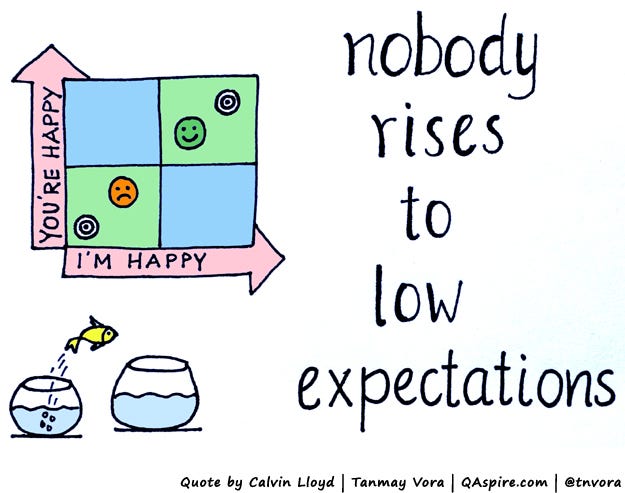
However, I have to acknowledge that expectations can be heavy. They don’t always lead to the desired outcome without having undesired effects. What happens when an individual doesn’t think they can meet expectations? This usually leads pressure that is make or break. Suddenly you feel like you’re being asked too much of you. Does this person even consider your feelings or ability? Their expectations may not even align with your wants so what gives them the right to ask such of you? This would be the negative effect of expectations.
Before moving on, I’d like to point out arguably the most important aspect of this — The expectations we put on ourselves. As humans it’s not uncommon for us to be our harshest critics. After all, nobody spends more time with us than ourselves. Every flaw, mistake and inadequacy is often clearer to us. I think the physiological effects of having low expectations of yourself is one of the worst pits you can fall in. It affects your mood, mental state and overall belief in achieving anything. Sometimes it’s not even your ability you doubt, it’s the disbelief that things will go well. Especially things that at times feel beyond our control such as landing your ideal job or truly experiencing love. Things that don’t come easy or immediately might have us feeling like they won’t come at all.
With all this said, how do we control our expectations? What is the key to avoiding disappointment without setting the bar so low that nobody can limbo? Well, it’s hard to give a one size fits all answer here. After all, our expectations don’t appear out of thin air. Each person has unique experiences and those shape our minds and how we think things will go. Regardless, I can still share what has worked for me in hopes it at least makes a slight difference to you.
I find that that having rigid expectations is a huge pitfall we may encounter. When I say rigid I mean the belief that things will go precisely the way you have planned without room for leeway. Life is unpredictable which makes it difficult to forecast the exact way things turn out. Still, they may go well. It may take more time, it might have a twist or two, but if ultimately, the main objective is met, is it really all that bad? I think giving room for uncertainty is important as it is just another part of the human experience. Things would be boring if everything was predictable. That comes from a desire for a level control far too unrealistic. Anticipate the unexpected and adjust your plans accordingly when met with it.
To build on that, I generally expect things to go well and more often than not, they do. I’ve read that expectations sometimes act as a self fulfilling prophecy. If you think things will end up well, they usually do and vice versa. We need to avoid creating danger that does not exist. Why clip your wings before you’ve tried to fly? The more we fear the fall the more likely it is to happen. Even if our expectations don’t affect outcome, they affect our state of being. With negative expectations, we feel tense and stressed whereas with positive expectations, we are more relaxed and able to act as normal. I lean towards the optimistic side of things without being unrealistic. It’s not naive or delusional, it’s hopeful.
Lastly, as I alluded to earlier, communication is king. Expectations generally stem from our intentions. What we intend to do or achieve is echoed into our consciousness and becomes expectation. Our intentions must first be clearly defined to ourselves before we can communicate them to others. This leaves little room for doubt and makes our relationships easier to navigate when both parties know what is desired.
With all this taken into account, we can then shape our expectations based on our experiences. Maintaining that positive yet realistic outlook, while adapting to uncertainties and shifts that come our way.
Before signing off, I’d like to touch a bit on entitlement. To feel entitled is to believe you are deserving of privileges or special treatment. There are things we are actually entitled to such as fundamental human rights or maybe benefits at work. That’s all fine and good, but I find that at times people misunderstand what they should be entitled to. What I mean is I see people project their expectations on others and parade them as things they’re entitled to. Turning your problem into someone else’s when it was never promised to you.
All of us are capable of making this mistake. In a world where we’re taught to chase after what we want and maybe even take it through force, I can understand why people feel this way. Nonetheless, it can’t run in reality. You cannot force your will on to others like this. By all means, feel entitled to things like love, money and happiness but don’t expect the world to cave in to your desires. Put in the work for these wishes. Make that promise to yourself that your effort will match your ambition rather than expecting it to be handed on a platter.

That brings me to the end of this writeup. Conclusively, expectations play a part in our day to day interactions. Everything starts from the mind so developing your mindset and worldview to align with your intentions will serve you well in the long run. Let us live life to the fullest and not paint a picture that leaves us feeling regretful.
I hope this helps put things in perspective.
Thanks for reading! That’s all for now.